

Introduction
The Seiko Speedtimer’s name certainly resonates in the world of motorsport history. The Speedtimer has grown from its original, groundbreaking, chronograph-themed Seiko Speedtimer to a full family of watches which combine vintage flair with contemporary reliability, a period when the watchmaking industry in Japan was subtly redefining the mechanical engineering rules. But, whether you’re an old hand at collecting and want to understand the history of the Speedtimer or you’re a newer collector who wants to know what this watch collection has to offer, knowing this story can help you understand why the collection remains so popular decades after it was first released.
The Origins: A 1969 Breakthrough
The original styling of the Speedtimer wasn’t the part that was remarkable, it was the engineering that went into it: Seiko’s in-house Caliber 6139 movement was, in 1969, the first to include a column wheel and a vertical clutch, both of which remain the foundations of good chronograph movements. When the 6139 arrived, Seiko was competing with the Swiss and others to create the automatic chronograph, and the Speedtimer was the first to get Seiko in the lead.
The 1964 Stopwatch Connection
The 1969 Caliber 6139 is the most famous forebear seiko speedtimer ssc965 price of the modern-day Speedtimer, but it’s not the only watch from the past that the collection shares ancestry with. In fact, Seiko’s timing heritage goes back further to a simple automatic chronograph with huge pushers and a white dial and a limited edition that was created for sports timing in the 1960s, which was a handheld stopwatch for use by sports officials. This detail is important because it reflects the fact that the Speedtimer collection isn’t just a single reissue, it’s a tribute to an era of Seiko’s efforts to accurately measure elapsed time — on an athlete’s wrist or on an official’s hand.
Complementing that tribute watch was a non-limited version with a sportier dark grey dial, but the same movement as the limited edition and other key watch characteristics, such as a 42.5mm case. These two watches would determine the direction Seiko would take for the Speedtimer’s revival: respecting the past and not just replicating it.
The Modern Revival: 2021 and Beyond
After years of primarily being a collector’s item and vintage listing, Seiko made a meaningful comeback to the Speedtimer in 2021 as part of its Prospex collection of watches, where it introduced new technology and design elements to revival the chronograph brand into the modern era. It was no coincidence that in 2021 the brand was celebrating its 140th anniversary — and it did so with six new chronographs, including two mechanical models and four solar-powered models of the Speedtimer.
This mechanical plus solar strategy is what has been the mainstay of the collection since then. It allows Seiko to provide something for almost every type of buyer, whether they’re looking for a traditional automatic movement, or low-maintenance convenience of solar power.
Mechanical Speedtimer: Old-School Craftsmanship
The mechanical movement that makes the seiko speedtimer ssc965 sizes and prices mechanical Speedtimer watches, the Caliber 8R46, is based on a column wheel and vertical clutch designed to provide smooth and reliable chronograph action, and is a direct nod to the architecture that made the original 1969 watch so important. The mechanical Speedtimer Chronograph collection includes several models with the same mechanical movement that feature different dial colors, hand design, and finishing details inspired by the original 1960s’ design.
The SRQ035 is among the most popular references of this nature, and was produced as an extremely limited edition with a run of 1,000 units. <cite index=”5-1″>It was a faithful rendition of Seiko’s 1/5th-of-a-second stopwatch, released only in a small quantity of 1,000 units</cite>. The dial of this watch is silver with a sunburst, and its pushers have vintage styling, so it’s one of the most collectable modern Speedtimers with an obvious historical connection.
Solar Speedtimer: Everyday Practicality
Armed with a light-powered movement called the Caliber V192, Seiko’s solar Speedtimer line is designed for those who just don’t want — or need — a mechanical movement. If you are like me, and want to have chronograph features without all the manual winding, or the concern about the power reserve on a watch that you leave in your desk drawer, then this movement is your answer.
The solar models are also faithful to the design aesthetics of the collection on the three-piece link bracelets, which are made of stainless steel, and share the V192 caliber in the lineup. It is housed in a compact case, by way of comparison, the blue-dialed SSC815 sits in a case that’s 39mm in diameter, 13.3mm thick and 45.5mm lug-to-lug, catering to a broad range of wrist sizes, unlike many of today’s sports chronographies.
Design Language: Function Meets Heritage
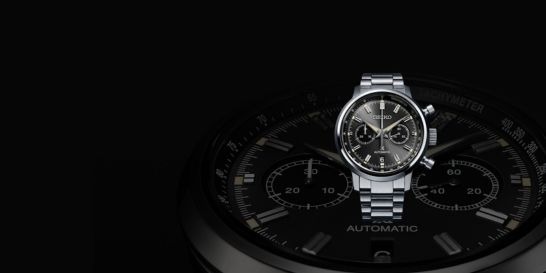
In both mechanical and solar types, the Speedtimer’s design concept has remained the same, that of readability, often with a 60-minute chronograph dial, a 24-hour counter, and a running seconds counter all designed for easy, on-the-spot reading. It’s not a coincidence — it’s the original intent of the Speedtimer name, a watch designed to be read quickly by athletes, race officials, and fans when the time is important.
A similar look is reminiscent of Seiko’s early ’70s chronographs, such as the 1972 reference 7V20 that’s been dubbed the “Panda” dial for its high-contrast appearance featuring a base dial and sub-dials of contrasting colors. The appearance of that detail in modern-day references, is a small but significant reminder of maintaining a history visible on the wrist.
However, because so many chronographs share a common subdial design and are based in motorsport, comparisons are inevitable—although visually similar to other racing chronograph designs, the Speedtimer is not a budget copy of its competitors, but rather a continuation of Seiko’s own, independently developed chronograph history.
Recent Collaborations and Limited Editions
Later the concept was continued with another “Datsun Editions” range of watches, which featured red and black theming inspired by the Datsun’s logo and featured mechanical and solar models, with the former being Japan-exclusive releases.
These partnerships are not merely of a cosmetic nature, they also reflect the notion that the Speedtimer was not simply a clock, but a result of a culture of speed, accuracy and competition that Japan helped shape in the 20th century.
Why the Speedtimer Still Matters
The appeal of the Speedtimer collection isn’t only for its seiko prospex men’s ssc813 speedtimer solar chronograph watch nostalgia value, it’s for its allure of honest mechanical lineage, careful modern engineering, and certainly for its lower price tag than many of its Swiss counterparts, which offer similar specs.
Some collectors are interested in hunting for certain limited references that are directly associated with Seiko’s past, such as the SRQ035. The solar-powered models have almost the same design “DNA” for the everyday wearer and a much lower maintenance requirement. In either case, the Speedtimer demonstrates that heritage, properly used, untouched by gimmick, can yield an engaging watch that is perfectly contemporary.
Final Thoughts
The Seiko Speedtimer is not trying to be 1969! It’s a traveling anthology that always celebrates its roots (via the movement architecture, dial design, and cultural collaboration) and is accessible, wearable, not just visually considered. If you have to go back to the history of Japanese chronographs, the Speedtimer is one of the most accessible & good.